| In
many of her songs, Mali’s great diva Oumou Sangare refers
to herself as 'Sangare kono', meaning Sangare the songbird.
To do so is a special priviledge of musicians from Wasulu in
the south of Mali.
The wisdom in Oumou’s powerful lyrics springs from her
experiences growing up in Mali’s capital, Bamako. Her
difficult childhood was the result of her mother being abandoned
by Oumou’s father when Oumou was just 2 years old, a very
traumatic event. Oumou’s father abandoned the family and
took a second wife and Oumou remembers her mother being extremely
depressed, weeping a great deal. Oumou’s mother was a
professional musician: as a sumu she would sing at weddings
and baptism celebrations. After her husband left her Oumou’s
mother was sometimes too downhearted and tired to participate.
However when she did, Oumou accompanied her and from age 5 began
to join in and was able to help her mother earn some money.
Oumou enjoyed these occasions and was very passionate about
Wassolou music. When her stunning voice was heard at a sumu
when she was 16, Oumou was recruited to become a member of the
group Djoliba Percussions and had the chance to tour Europe.
She was their lead soloist and then went on to form her own
band. A few years later aged 21 Oumou recorded her first album,
Moussoulou (Women), released in 1990. It caused a great
stir because of the subjects in the lyrics which were not usually
publicly expressed, most notably her big hit 'Diaraby Nene (The
Shivers of Passion)', and also her chosen rhythm. Oumou's songs
use the resonating jittery sound of the kamalengoni - the youth
version of the hunter's harp. The radical mission of her songs
is to highlight the issues that women in Mali face, especially
polygamy.
Further
albums in the 1990s were Ko Sira and Worotan.
A
double
CD
simply entitled Oumou (2003) includes notes on the
songs provided by Oumou herself. It is a 20-track compilation
of 12
songs from her existing CDs plus 8 tracks
not previously on CD. DJs promoted 'Yala' as one of the best
dance
|
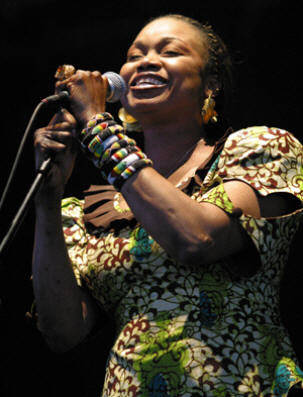
photo:
© Philip
Ryalls
tracks
on the album. A few of the songs give advice to young people,
such as 'Djorolen' and 'N'Guatu'. You
don’t have to look very far to find one of Oumou’s
songs on African music compilations – Empresses of
Africa and Africanesque are just a couple. Several
of Oumou’s songs feature on the soundtrack of the
powerful movie Beloved (1998).
Since 2000 Oumou has concentrated on producing music for the
Malian market and a few other projects, including the building
of a hotel called Hotel Wasulu, supporting an orphanage in Bamako
and touring countries in Africa. As
the UN Ambassador for the F.A.O. she
campaigns against world hunger.
In January
2003 Oumou participated in Festival in the Desert in the northern
part of Mali, her presence was notable because of the recent
civil war in the North. Her song 'Wayena' is on the festival
CD. Later the same year Oumou was at international summer festivals
including WOMAD festival in Reading UK. She was in London for
the Jazz Festival in November 2003 as part of a major international
tour.
Six years since her last CD, Oumou's new CD Seya (2009)
has songs with messages and rhythms that appeal to her fans
in Mali and worldwide. Well-known musicians who play on some
tracks are Bassekou Kouyate and Benego Diakite.
Oumou’s performances on stage are truly spectacular as
she and her dancers spin calabashes in the air.
|








 Oumou
Sangare
Oumou
Sangare